Unintegrated Success

Written by Nick Vonpitt
There is a version of success that looks exactly right from the outside and feels completely hollow from the inside.
You've built the business. You have the income, the recognition, the life that other people point at when they talk about making it. And yet somewhere in the middle of all of it, something quietly stopped landing. The achievements arrive and you move straight to the next one. The milestones pass and you feel nothing or worse, you feel afraid. Afraid it will be taken away. Afraid that if you stop, everything collapses.
This is not burnout. It is not a motivation problem. It is not your relationship, your routine, or your lack of gratitude. It is what happens when your external life outgrows your internal capacity to actually live it.
I call it unintegrated success. And it is far more common than anyone admits.
The gap nobody names
For a long time, I thought success was something I had to earn before I got to rest. Before I got to be present. Before I got to actually show up for the people and the life I said I was building toward.
So I kept building. And the more I built, the more I had to protect. And the more I had to protect, the harder I worked. And somewhere in that cycle, I became completely unavailable — to my family, to myself, to any version of my life that existed outside of what I was producing.
I remember sitting at my desk while my kids played on the floor. If you'd taken a photo, it would have looked like everything was fine. But I wasn't there. And when they'd come over and ask me to come look at something, I'd say, "just give me a minute."
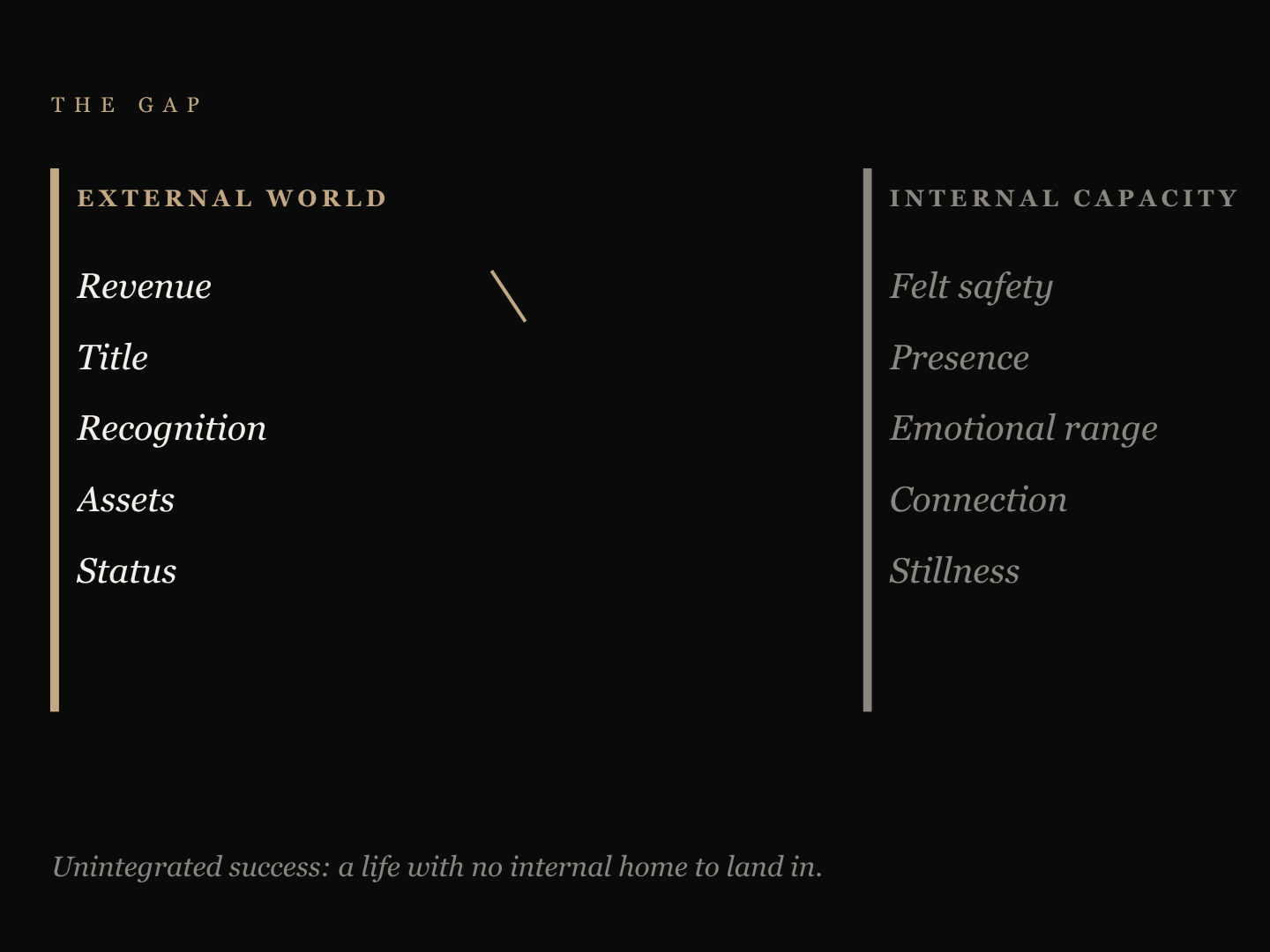
Growth without integration creates the gap.
Whatever it is, the way you tell your story online can make all the difference.
I gave a lot of minutes away.
That is the gap. Not the gap between where you are and where you want to be — the gap between what you've built and your ability to actually experience it. Between the life you've created and the internal capacity to receive it.
Most high performers spend years growing their external world by design. Revenue, reputation, reach — all of it built with intention and discipline. But internal capacity? That grows only by accident, or by crisis. And for most of the high performers I work with, it hasn't grown at all. It has been left behind entirely.
Watch the full breakdown
If this is landing, there’s a deeper unpacking of this conversation here.
This will give you more context around why this happens — and what most high performers get wrong when they try to fix it.
Why success doesn't fix it
Here is what I've watched happen, inside myself and inside the people I work with: we fuse our identity to our output so completely that achievement becomes the only thing that feels like proof we exist.
Not consciously. This is not a choice anyone makes. It begins long before the success arrives — usually as a survival strategy, a way of earning safety or love or belonging by performing well enough. Success doesn't create this pattern. It just validates it. And then it amplifies it.
"I am what I produce" becomes the operating system. And once that's running, no achievement can actually reach the wound underneath it, because the wound is not about performance. The wound is about worth.
So the internal critic doesn't quieten after you hit the goal. It recalibrates. A new ceiling appears immediately. What was once enough becomes the new floor. And the goalpost — the one that was supposed to bring the relief, the rest, the presence — moves again.
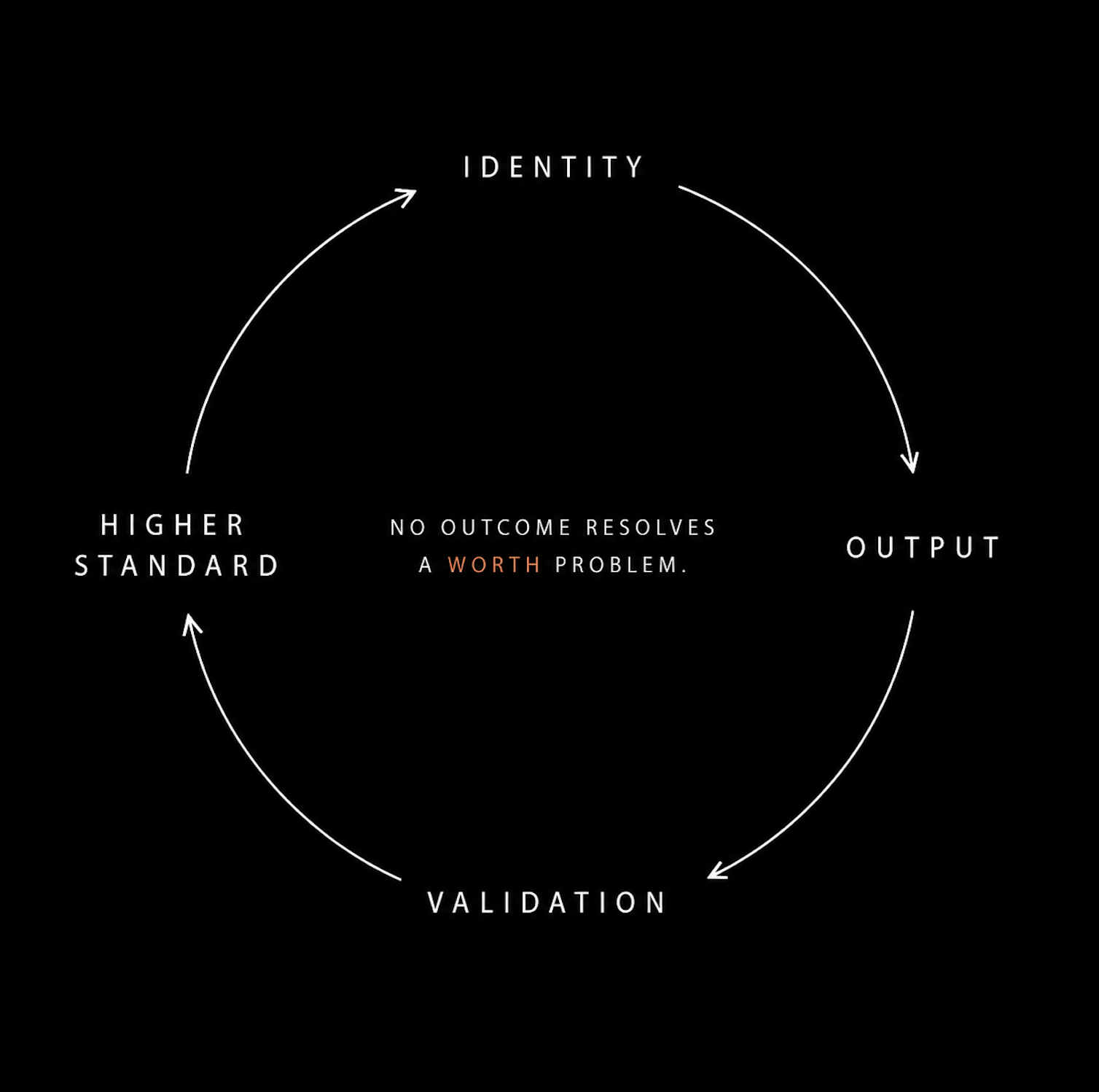
No outcome resolves a worth problem.
I had a client not long ago, a seriously successful business owner, who got so triggered by this conversation that he went and bought more things. More cars. Another yacht. Not because he wanted them. Because he literally did not know what else to do. He needed to physically see something — to have something tangible in front of him — because he was struggling to feel what was wanting to be felt.
That is what unintegrated success looks like at its extreme. But I see quieter versions of it every day. The person who checks their phone during dinner. Who answers emails at midnight not because they need to but because stopping feels unsafe. Who describes their marriage as fine and means functional. Who looks at their life and asks, quietly, in the spaces between everything — why does none of this feel like I thought it would?
What it costs in the places that matter most
The nervous system doesn't distinguish between a business threat and an intimate moment. It responds to activation. And when someone has been running in chronic stress for long enough, their nervous system reads vulnerability — the exact thing that intimacy requires — as danger.
This is not a lack of love. It is a depletion of capacity. By the time many high performers come home, they have spent everything. Their family doesn't get the leftovers. They get the absence. They get someone who is physically in the room and entirely somewhere else.
Children are exquisitely sensitive to this. You can be generous, providing, present in every logistical sense — and still not there. They feel the gap. And in the absence of an explanation, they fill it with stories about themselves.
Partners feel it too, even when they can't name it. The relationship becomes functional — bills paid, schedules managed, no major conflict — but the connection quietly disappears. Two people sitting side by side, miles apart. Not broken. Just slowly becoming unbearable in a way neither person has the language for yet.
I lived that. And the honest thing I can say is: it had nothing to do with how much I cared. It had everything to do with what I had left to give after I'd given everything to the build.
What integration actually requires
Integration is not a morning routine. It is not a sabbatical, a digital detox, or a better work-life balance strategy.
It is building an interior that can hold what you've built.
It starts with one honest question — and I mean genuinely honest, the kind that requires you to stop bullshitting yourself for a moment: Is the way I'm living sustainable? Not the business. The life. Am I actually honouring the people I say matter most to me? And more than that — am I honouring myself, and the experience I'm having?
Because if you're not excited to come home — if presence feels like an obligation rather than something you want — something needs to be looked at. Not fixed. Looked at.
The first move is not a practice. It's a seeing. You have to be able to see the gap between your identity and your behaviour before anything else becomes possible. To recognise that you have been behaving as per a role — and that the role, no matter how convincingly you've played it, is not who you are.
That seeing — that moment of relief, actually — is what I watch happen when someone finally lets themselves look honestly. It sounds something like: I'm allowed to feel this and be successful. I'm allowed to be a person and do this thing. I don't have to choose.
In practice, integration looks different for everyone. For me it began with slowing down in ways that felt almost unbearably unproductive. Morning and evening journaling, not for output but for honesty. Leaning into uncomfortable conversations rather than managing around them. Learning to be in my body, not just in my head. Practicing presence not as a productivity tool but as a different relationship with myself — one that didn't require anything from me in return.
It used to be glimpses. Brief moments of actually being in my life. Now I sip on it far more than I used to. I don't glance over these moments and move on. I sit in them. I know they're fleeting and I let that make them matter more.
What you actually want
I'll close with this.
You've spent years building something real. Something most people won't ever build. And somewhere in the middle of all of it, you stopped being in it.
Not because you're broken or that you don't care. But because the life built got a whole lot bigger, and nobody taught you how to grow the ‘inside’ (you) at the same rate.
A question worth sitting with isn't "how do I do more" — it's "who am I when I'm not performing?" Not "what's next" — but "am I actually here for this?"
Because at the end of all of this, you want people to remember more than what you built.
You want them to remember how it felt to be around you.
Make the shift.
The work doesn't end when the reading does.
If something in this piece landed — a recognition, a discomfort, a quiet knowing — that's worth paying attention to. There are two places to go from here.
The Power Leak Scorecard
Most high-performers aren't broken. They're leaking. This scorecard helps you locate exactly where your energy is bleeding — so you know what to work on first.
Take the scorecard →Work With Nick
If you're a high-performer who looks successful on the outside but feels something is off underneath — this is the work. A conversation costs nothing. Your current state might.
Apply to work together →
Nick Vonpitt works with executives and entrepreneurs navigating burnout, identity strain, and the gap between external success and internal alignment. Based in South Africa. Available internationally.