The Silent Killer of Leadership, Performance, and Relationships
Written by Nick Vonpitt
Why unspoken expectations are costing high performers their edge — and how to name what you've never said.
There's a particular kind of exhaustion that doesn't show up on a blood test.
It doesn't come from working too hard, though you probably do. It doesn't come from a lack of discipline, vision, or commitment — you have all of those in abundance. It's the exhaustion of living with a gap between what you expect and what you say out loud. Between who you are at work and who you're becoming everywhere else.
If you've spent your career being the person who sees the bigger picture, holds the room together, and makes the hard calls with clarity — you know the weight of that role. You also know, if you're honest, that the clarity you bring to a boardroom sometimes disappears the moment you walk through your own front door.
This is the thing most high performers won't admit: the skillset that makes you exceptional in your professional life can quietly dismantle your personal one. And the mechanism is almost always the same.
Unspoken expectations.
When you stop saying the thing
Let me tell you about a client — we'll call him Mark.
Mark was a COO. Sharp, composed, respected. He led global teams across time zones and had the kind of strategic clarity that made him irreplaceable to his company. He was, by every external measure, an excellent communicator.
But his marriage was falling apart.
"I don't get it," he told me in our first session. "I lead people for a living. I know how to communicate. Why does my wife keep saying she can't read my mind?"
What Mark had done — unconsciously, over years — was outsource the emotional labour of his relationship to assumption. He assumed she knew he cared, because he came home every night. He assumed his long hours were understood as devotion, not abandonment. He assumed that financial stability communicated love.
None of those things were wrong. They just weren't said.
And over time, the gap between what he felt and what he expressed had calcified into something they both lived inside — a quiet distance neither of them could name, but both of them felt.
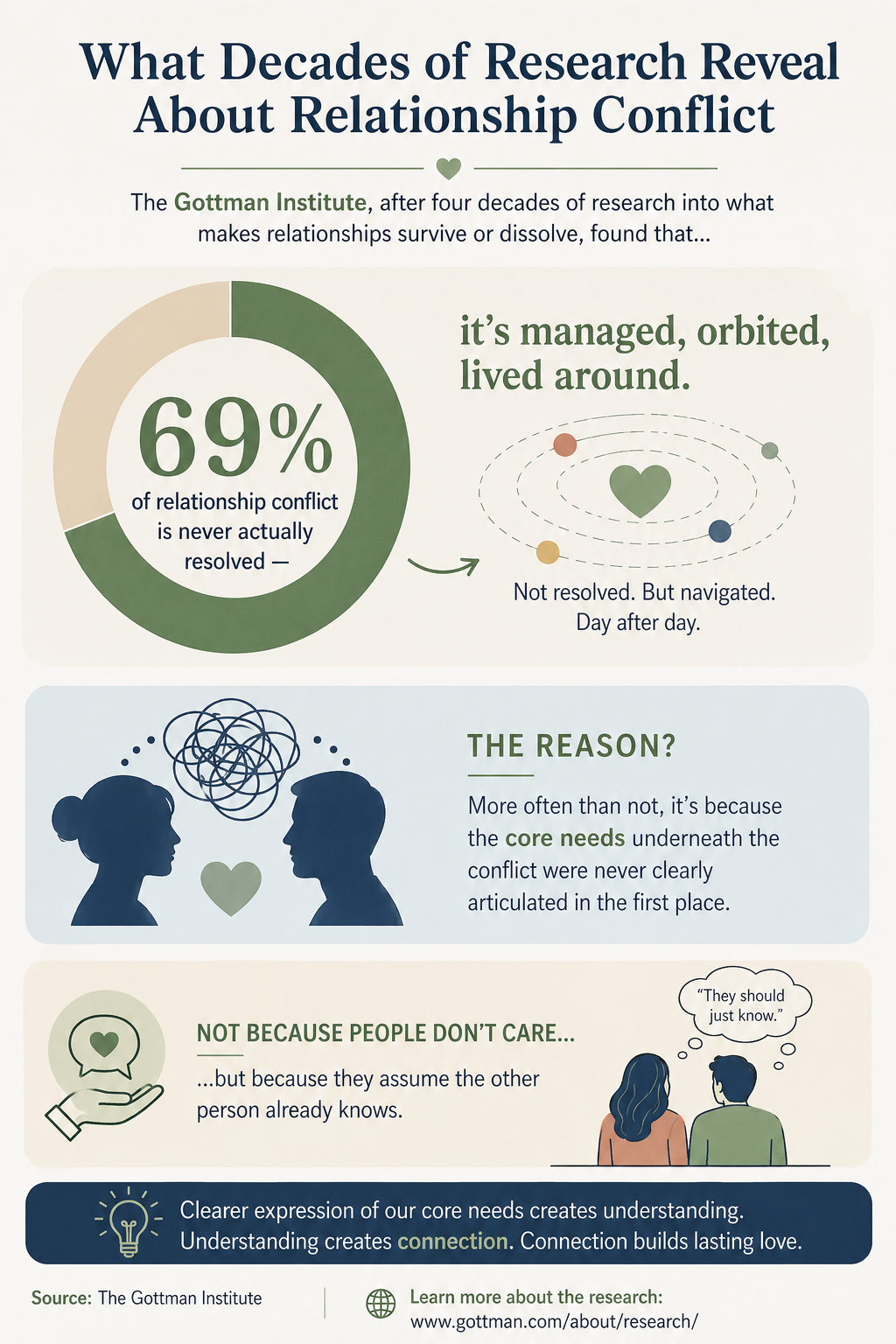
The Gottman Institute, after four decades of research into what makes relationships survive or dissolve, found that roughly 69% of relationship conflict is never actually resolved — it's managed, orbited, lived around.
The reason, more often than not, is that the core needs underneath the conflict were never clearly articulated in the first place. Not because people don't care, but because they assume the other person already knows.
Mark had been managing his marriage the same way. Efficiently. From a distance.
The boardroom bleeds into the bedroom
What surprised Mark — and surprises most of the leaders I work with — is that this pattern doesn't start at home. It starts at work and gets reinforced there, until it becomes the default way they move through the world.
High-performing leaders often operate in environments where directness is rewarded, but vulnerability is quietly penalised. You learn to communicate the what without the why. You get results, so no one asks questions. And somewhere along the way, clarity becomes transactional — a means to an outcome, rather than a way of being in relationship.
The cost of this, professionally, is significant. Research from MIT's Human Dynamics Laboratory found that communication patterns — specifically, how openly and frequently people exchange information — are among the strongest predictors of team performance, more so even than individual skill or intelligence. And a large-scale survey by Salesforce found that the majority of executives and employees point to ineffective communication as the primary driver of workplace failure.
But the cost personally is harder to measure and easier to ignore — until it isn't.
Because the same leader who can articulate a three-year growth strategy in a 20-minute presentation sometimes can't tell his partner what he actually needs at the end of a hard week. The same woman who runs a 200-person team with calm authority sometimes can't ask her children for space without feeling like she's failing them.
The skills transfer upward. The vulnerability doesn't always follow.
What radical clarity actually means
This isn't about becoming a different person. It isn't about over-explaining yourself or processing every emotion in real time or suddenly turning your one-on-ones into therapy sessions.
Radical clarity is simpler than that, and harder.
It's saying the thing you're assuming the other person already knows. It's naming the expectation before the resentment has a chance to build. It's choosing, again and again, to give people the map instead of testing whether they can read your mind.
For Mark, it started with something small. A conversation with his wife — not about the state of their marriage, but about what he actually needed from her after a difficult day. Not transactional. Not efficient. Just honest.
He told me it felt almost uncomfortable. Like using a muscle he'd forgotten he had.
But that conversation opened something. And the next one was easier. And the one after that.
What he discovered — and what I've watched happen with leaders across industries and continents — is that when you name your expectations, you don't make yourself smaller. You make yourself real. And that realness is what trust is actually built on.
Research in organisational psychology has consistently shown that psychological safety — the felt sense that it's safe to speak up, to be uncertain, to be honest — is the single most important factor in high-performing teams. Google's own internal research, Project Aristotle, found this to be true across every team they studied. Not talent density. Not process efficiency. Safety.
The same is true in the teams we call families.
The question worth sitting with
If you've read this far, something in it landed.
Maybe you recognised Mark. Maybe you recognised yourself.
The invitation isn't to audit every relationship in your life or to turn your next dinner conversation into a feedback session. It's quieter than that. It's just this:
Where are you silently expecting someone to know something you haven't said?
Where have you been leading people at work — and managing people at home?
Where is the gap between what you feel and what you actually express slowly costing you something you can't get back?
You don't have to answer those questions publicly. But they're worth sitting with. Honestly. Without judgment.
Because the leaders who change the rooms they walk into — the ones who build something that lasts, in business and in life — aren't the ones who have it most together. They're the ones who are most willing to say the true thing, even when it's uncomfortable.
That's the work.
The work doesn't end when the reading does.
If something in this piece landed — a recognition, a discomfort, a quiet knowing — that's worth paying attention to. There are two places to go from here.
The Power Leak Scorecard
Most high-performers aren't broken. They're leaking. This scorecard helps you locate exactly where your energy is bleeding — so you know what to work on first.
Take the scorecard →Work With Nick
If you're a high-performer who looks successful on the outside but feels something is off underneath — this is the work. A conversation costs nothing. Your current state might.
Apply to work together →
Nick Vonpitt works with executives and entrepreneurs navigating burnout, identity strain, and the gap between external success and internal alignment. Based in South Africa. Available internationally.
references
1. Gottman Institute — The 69% Conflict Finding Dr. John Gottman's research, drawn from over 40 years of longitudinal studies at the Gottman Love Lab, found that 69% of relationship conflicts are "perpetual problems" — rooted in deep personality and values differences that never fully resolve. The key isn't resolution; it's how couples navigate them.
Source: The Gottman Institute — Research Overview
2. MIT Human Dynamics Laboratory — Communication as the #1 Team Performance Predictor Professor Alex "Sandy" Pentland's research at MIT's Human Dynamics Laboratory, published in Harvard Business Review (April 2012), found that communication patterns were the single strongest predictor of team success — more significant than intelligence, skill, or personality combined.
Source: The New Science of Building Great Teams — Harvard Business Review
3. The 86% Communication Statistic A note here: this statistic is widely cited as "Salesforce," but the original source is actually a survey by Fierce, Inc. (2011), which surveyed over 1,400 corporate executives, employees, and educators. Salesforce republished and cited it in a blog post, which is likely where the attribution came from. Worth citing the original.
Source: Fierce, Inc. — Employees Cite Lack of Collaboration for Workplace Failures Or the Salesforce attribution if you prefer to keep it: Salesforce — How Soft Skills Are Crucial to Your Business
4. Google Project Aristotle — Psychological Safety Between 2012 and 2014, Google analyzed over 250 attributes across 180 internal teams and found that the single most important factor distinguishing high-performing teams was psychological safety — the felt sense that it's safe to speak up, take risks, and be honest without fear of judgment.
Source: Google re:Work — Understanding Team Effectiveness