The Capacity-Safety Loop

Why Success Creates the Problems It Was Supposed to Solve
There is a question that sits underneath almost every founder, executive, and leader I work with and it's surprisingly simple: why does success often create the very problems it was supposed to solve?
By most external measures, these are intelligent people or people that have been industreous in there approach. They have built businesses, solved complex problems most people will never encounter and many have created opportunities for others.
And yet, privately, they are often living some version of the ‘same reality’. They struggle to switch off. They tend to notice themselves becoming reactive to small things. Their relationships feel thinner, less connected than they once did. The business seems to demand more from them despite — or because of — becoming more successful. A byproduct being that their decision making becomes slower and worst for wear, alongside a growing emotional burden.
There's a specific look I see when I sit across from someone in this position. It's the look of someone who has tried every strategy, every system, every ‘framework’ but hasn't been willing to look at themselves. That look is usually the first sign I'm not dealing with a strategy problem, a time problem or a productivity problem. I'm dealing with a capacity/identity problem.
The irony is that they know more than they ever have, AI has aided this process significantly. Yet they often feel less valuable and effective than they did years earlier. Knowledge is increasing. Capability is increasing. Responsibility is increasing. But their capacity and perceived value is decreasing.
Most people respond to that gap by assuming they need a better strategy. What they actually need is a better understanding of the system that's carrying the strategy. That distinction sits at the centre of everything that follows.
Capacity Is Not What People Think It Is
Most people define capacity incorrectly. They think capacity is time — “I don't have enough time.” Or energy — “I need a holiday.” Or productivity — “I need better systems.”
Those things matter. But they're downstream variables, not the ‘thing’ itself.
Capacity is better understood as the ability to maintain access to your highest level of thinking, feeling, discernment, creativity, and decision-making — while carrying increasing levels of responsibility. Imagine being able to unlock a space that allows you to hold all of that? It’s built in, it is always there and you can access it.
This is why two leaders can experience the exact same external conditions and produce radically different outcomes. The difference isn't the circumstance. The difference is the system interpreting the circumstance. One nervous system experiences challenge. Another experiences threat. One remains adaptive. The other becomes protective.
That distinction changes everythin because once the nervous system perceives threat, performance stops being the primary objective. Survival ends up being the focal point of the system and it is extraordinarily expensive.
Research out of Yale School of Medicine, led by neuroscientist Amy Arnsten, has shown precisely what happens to the prefrontal cortex — the seat of judgment, discernment, and long-range thinking — under sustained stress. The synaptic connections that hold information and maintain executive control don't just slow down. Under chronic load, they physically weaken. Meanwhile, the pathways governing fast, automatic, emotional reaction strengthen. The brain isn't malfunctioning. It's doing exactly what it evolved to do — prioritising speed over nuance in the face of what it interprets as threat. The problem is that the threats facing a modern leader are rarely physical or immediate. They're reputational, relational, financial, and unfolding over years — so now imaging a nervous system built for split-second survival - you’re guaranteed to have a poor instrument for that kind of decision making.
The Invisible Relationship Between Safety and Performance
Most leadership literature treats psychological safety as a team dynamic — something a leader ‘creates for other people’. Personally I think that's incomplete. Safety begins long before it reaches the team it begins inside of the leader.
When I talk about safety, most assume I mean giving up or softening, even lowering the bar, missing targets and deadlines. I understand exactly why they assume that. What is being asked is - do you feel safe within yourself, in the decisions you're making? That internal safety is what creates real certainty — not certainty about outcomes, but certainty about your own ground to stand on while making the decision.
Internal safety precedes organisational safety. A leader who doesn't feel internally safe will unconsciously use the organisation to create safety for themselves. This shows up everywhere: control, micromanagement, perfectionism, over-functioning, an inability to delegate, difficulty receiving feedback, defensive communication, a need for certainty, urgency addiction, constant monitoring.
At first glance, these look like behavioural issues. They're not. They're safety strategies. The nervous system is trying to reduce uncertainty the only way it knows how. The problem is that the very strategies designed to create safety eventually destroy it. The leader becomes overloaded. The team becomes dependent. Decision-making centralises. Innovation decreases. Truth gets delayed. Performance eventually declines.
This isn't speculation about team dynamics — it's one of the more robustly tested findings in organisational research. Harvard Business School professor Amy Edmondson discovered it almost by accident in the 1990s, while studying medical error rates in hospital teams. She expected the best-performing teams to report the fewest mistakes. Instead, she found the opposite: the highest-performing teams reported more errors — not because they made more mistakes, but because they were the only ones willing to admit them. The lower-performing teams were hiding theirs. Edmondson's subsequent research, and Google's later Project Aristotle study of 180 of its own teams, both arrived at the same conclusion: psychological safety isn't a soft cultural nice-to-have. It's the single strongest predictor of team performance ever measured in either body of research — stronger than skill, tenure, or shared personality traits.
This is why internal safety isn't a wellness conversation. It's a performance conversation — maybe the most important one available to leaders today.
The Capacity-Safety Loop
This is the part that explains this idea.
Leadership performance isn't linear. It's cyclical. Every leader exists inside a continuous feedback loop: internal state influences decision quality. Decision quality influences psychological safety. Psychological safety influences organisational performance. Organisational performance influences the leader's own capacity. And the cycle begins again.
This reveals something most leadership models miss entirely: the leader isn't merely influencing the organisation. The organisation is feeding back into the leader. Every decision either strengthens or weakens the loop. Every interaction either increases or decreases capacity. Every moment of truth either expands or contracts safety.
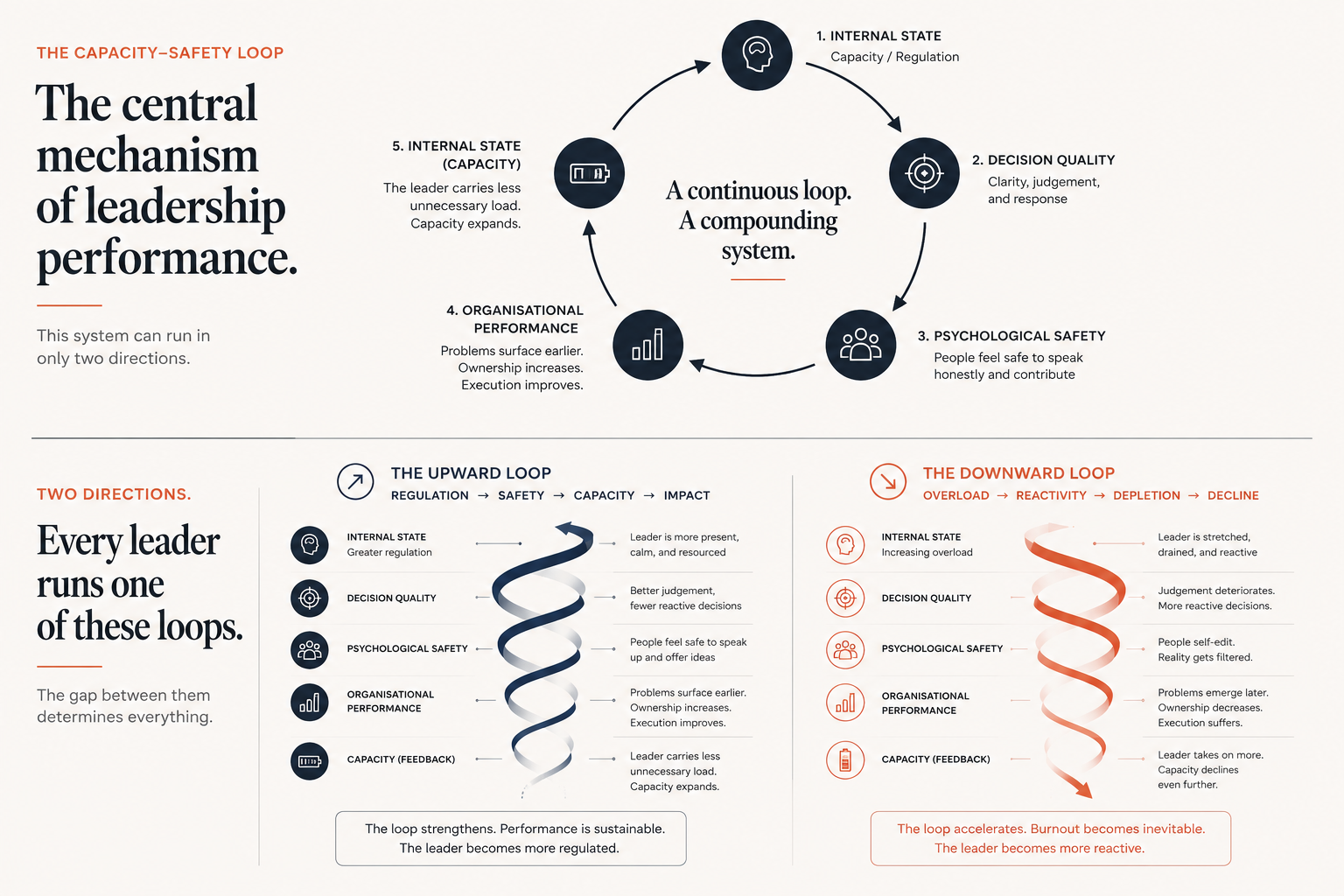
There are only two directions this loop can run.
The Upward Loop. A leader develops greater internal regulation. Decision quality improves. People feel safe enough to speak honestly. Problems surface earlier. Ownership increases. Execution improves. The leader carries less unnecessary load. Capacity expands. The leader becomes more regulated. The loop strengthens. This is what sustainable performance actually looks like from the inside.
The Downward Loop. A leader becomes increasingly overloaded. Decision quality deteriorates. Communication becomes reactive. People stop surfacing reality, because it no longer feels safe to. Problems emerge later — usually after they've already escalated. The leader takes on more responsibility to compensate. Capacity declines further. The leader becomes more reactive. The loop accelerates. This is how burnout actually happens — not suddenly, but systemically, one small compounding step at a time.
I think this is also the mechanism behind something I've said before: the people you work with get the best of you, and the people you love get what's left. That happens because you end up spending all your energy on external things — and you haven't learned to delegate effectively, or to point responsibility back to where it actually belongs. More importantly, you're often not even aware it's happening. You genuinely can't tell whether you're in a resilient phase or just enduring — because enduring still lets you bounce back to “normal,” so it feels like resilience. It's just a mechanic you keep repeating. The shift only happens when you're willing to dive in and consciously let whatever you're navigating actually teach you something about yourself. At that point, the pattern starts to dissolve, because it's finally being metabolised instead of just survived.
“The most dangerous patterns aren’t the ones we notice.
They’re the ones that become normal.”
The Missing Piece: Identity
Most leadership conversations stop at behaviour. Most psychological conversations stop at trauma. Most business conversations stop at strategy. Very few connect identity — and identity might be the hidden variable underneath all of it.
Here's where I think the real confusion lives: we believe identity and behaviour are the same thing. They're not. Identity is something you innately have — think about how you expressed yourself as a child, before any expectations were placed on you. That expression wasn't about discipline. It was just a soulful being expressing itself. Behaviour, on the other hand, ties into skill and strategy — things that can be learned, unlearned, and rebuilt. When we cross-pollinate the two — when behaviour gets treated as evidence about identity — that's exactly where the bottleneck forms. People take feedback on their behaviour personally, as if it's a verdict on their character. It isn't. It's just something they learned, which means it's something that can be re-learned.
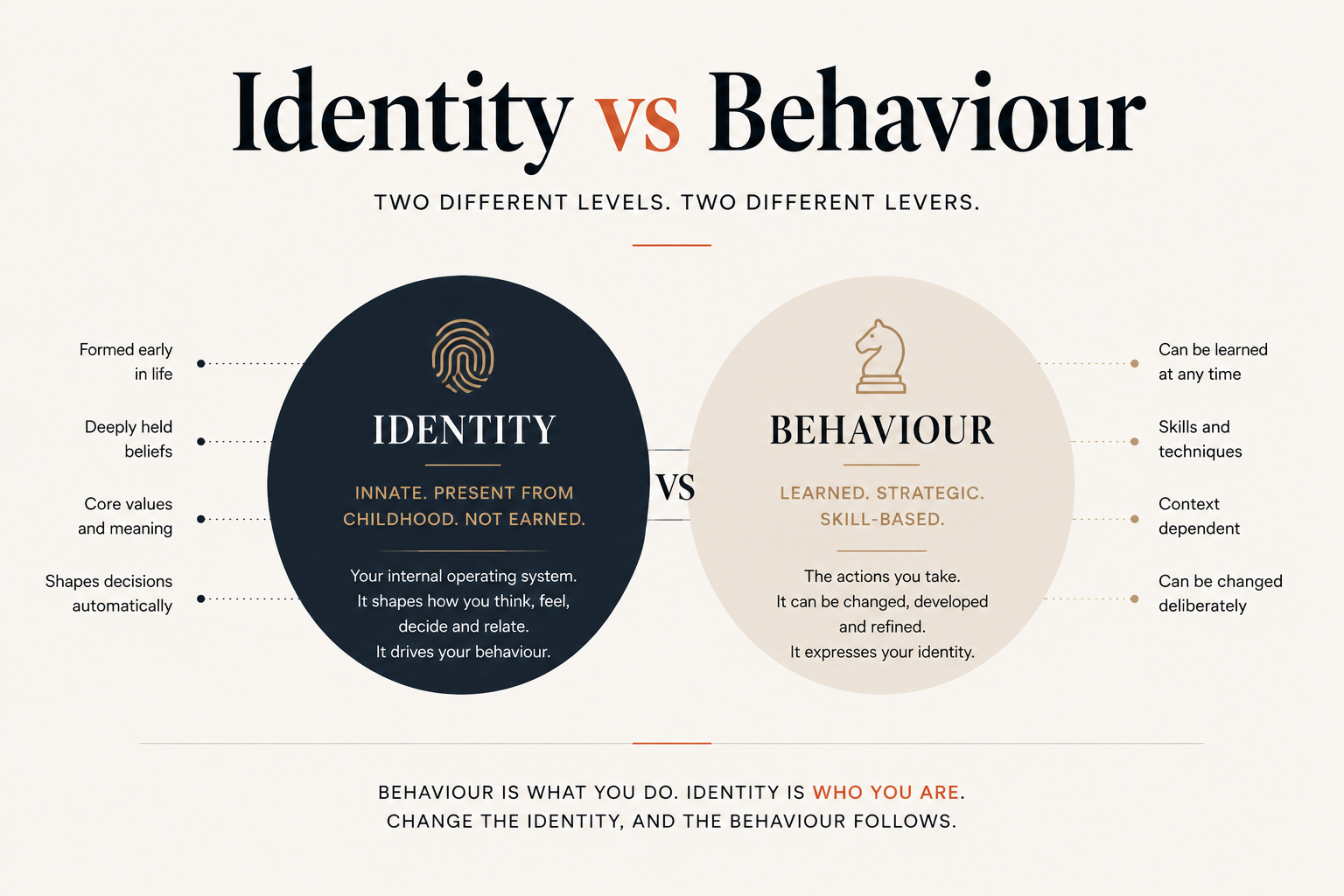
Identity vs Behaviour
I see this show up as specific liabilities in leaders: needing to be over-controlling, feeling like you have to lead from the front every single time, being unwilling to let go of things, believing that aggression is what moves the needle, distancing yourself from people, a situation, or even your own family. And maybe most quietly damaging of all — chronic avoidance. I've watched founders who know exactly what they should be addressing do everything in their power not to go there.
Underneath all of it sits something quieter still: a slow disconnection from their own signals. They keep meeting every obligation in front of them while quietly ignoring the ones coming from inside — the fatigue they override, the discomfort they talk themselves out of, the need they don't name because naming it feels like a liability. It isn't dramatic. It's just consistent. And consistency is exactly what makes it invisible to the person living it.
If my value comes from achievement, slowing down becomes dangerous. If my worth comes from competence, making a mistake becomes dangerous. If my identity comes from being needed, delegation becomes dangerous. The nervous system doesn't distinguish cleanly between a threat to survival and a threat to identity — which is why so many intelligent people keep repeating behaviours they consciously know are unsustainable. The behaviour is serving the identity. The identity is serving the nervous system. The nervous system is serving safety.
So the real question isn't “why won't they change.” The real question is: what would changing require them to stop believing about themselves?
What Changes First
When someone finally begins rebuilding capacity correctly, the shift isn't dramatic, and it doesn't take six months to show up. The first thing that changes is much quieter than that: they realise — “I've been doing this wrong, and I've been seeing myself wrong.” That recognition alone creates an enormous amount of freedom and space, often before a single external thing has actually changed.
The One Sentence Summary
If I had to reduce the entire method down to one sentence it would be this: Make the decision to frequently align yourself with your why.
Not a what. Not a how. A why.
And if that one sentence has a destination, it's this: become someone your success can safely sit upon. Not someone performing readiness for it. Someone who has actually built the internal architecture to hold what they've created. This is where most of us get it wrong. We create something incredible but we have not developed the skills, or shifted our nervous system to hold it all.
Feel free to Go Deeper
This article is the written foundation of a body of work built out over four weeks this month — The Capacity Crisis. If you want to see the full argument made out loud, with the research walked through and the diagrams built in real time, the companion video — Capacity Before Strategy: The Foundation Every Leader Is Missing — covers the same ground in a longer, more conversational format.
Capacity Before Strategy: The Foundation Every Leader Is Missing
And if you want something to actually sit with afterward, The Capacity-Safety Loop: A Field Guide for Leaders takes the framework from this article and turns it into a working tool — the Shame Flywheel, the Sturdy Gap, and the Loop itself, each with reflection questions built in. It's available as a free download.
A final thought
If there’s one thing I hope you take away from this guide, it’s this.
You’ve spent years building something meaningful. A business. A career. A family. A reputation. Yet somewhere along the way, many leaders quietly stop experiencing the very life they worked so hard to create. They continue showing up, making decisions, carrying responsibility and solving problems, but they no longer feel deeply connected to any of it.
That isn’t because they’re weak, broken, or incapable. More often, it’s because the demands placed upon them have grown faster than their internal capacity to carry them. Nobody teaches us that as our responsibilities expand, our inner world needs to expand alongside them.
This is why I believe so many leaders think they have a strategy problem when, in reality, they have a capacity problem. The Capacity Safety Loop is simply a way of making that invisible process visible. It explains why decision-making begins to narrow, why creativity starts to disappear, why relationships lose their warmth, and why success can eventually feel more like something to maintain than something to enjoy.
The encouraging part is that this isn’t permanent. Capacity can be rebuilt. Safety can be restored. As that happens, clarity begins to return. Decisions become cleaner. Relationships become easier to inhabit. Leadership feels less like carrying the weight of the world and more like responding wisely to what’s in front of you.
Ultimately, the goal was never simply to build a successful life. It was to build one you could actually be present for.
Because at the end of all of this, people are unlikely to remember every milestone you reached or every achievement you accumulated. They’ll remember what it felt like to work with you, to lead alongside you, to live with you, and to be loved by you.
To me, that’s the real measure of leadership. Not what you built, but whether you were truly present enough to experience it and whether the people around you felt your presence while you were building it.
You can make the shift.
The work doesn't end when the reading does.
If something in this piece landed — a recognition, a discomfort, a quiet knowing — that's worth paying attention to. There are two places to go from here.
The Capacity Assessment
Most high-performers aren't broken. They're leaking energy. This scorecard helps you locate exactly where your energy is bleeding — so you know what to work on first.
Take the scorecard →Work With Nick
If you're a high-performer who looks successful on the outside but feels something is off underneath — this is the work. A conversation costs nothing. Your current state might.
How we can work together →
Nick Vonpitt works with executives and entrepreneurs navigating burnout, identity strain, and the gap between external success and internal alignment. Based in South Africa. Available internationally.