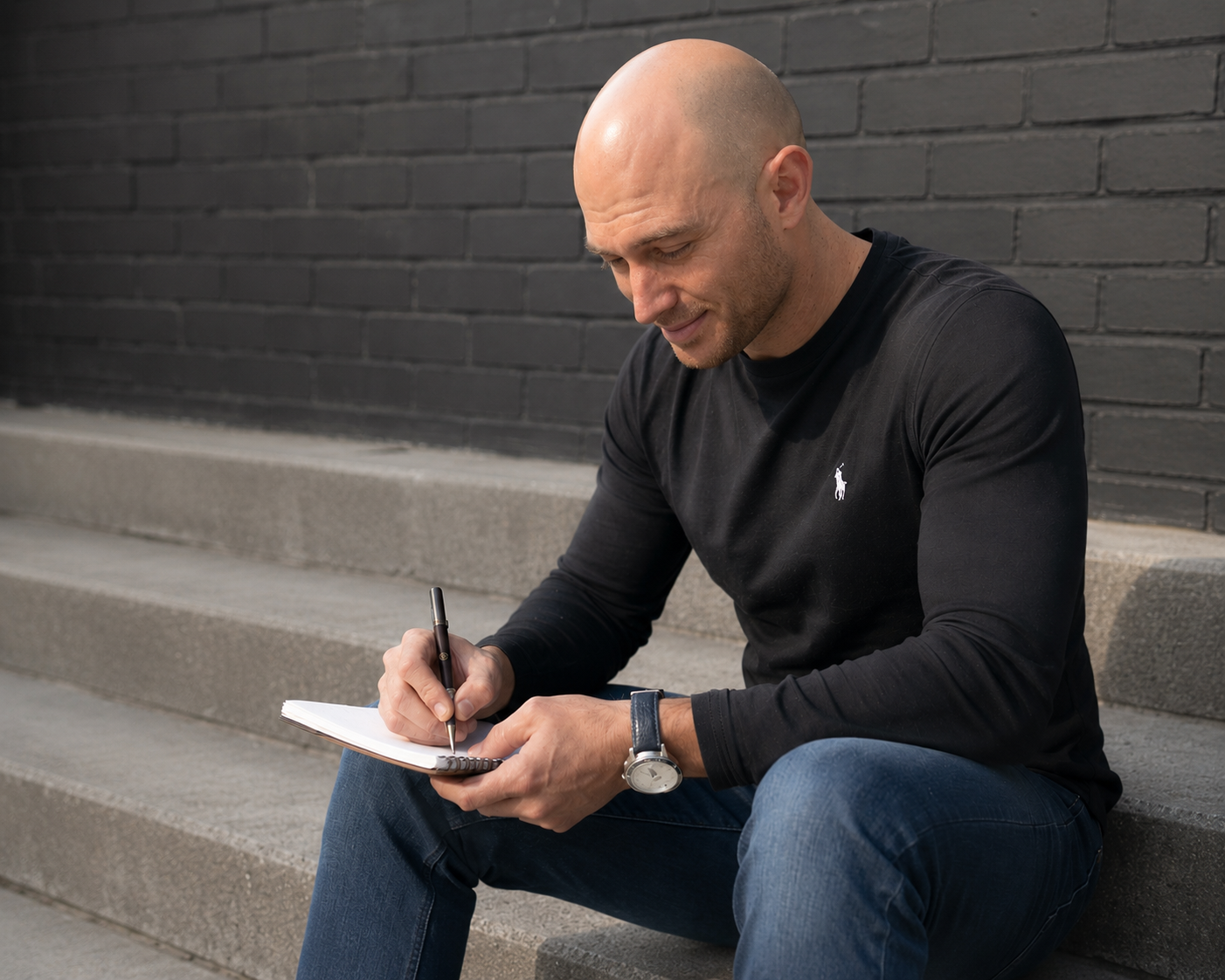
About Nick Vonpitt
There is a version of success that looks exactly right from the outside and quietly hollows you out from within. I know that version well. I lived it for longer than I want to admit.
Who I Was
For years, I was the person who held it together. I was building businesses, managing teams, carrying financial pressure that affected more than just me, and showing up every day as the version of myself who had the answers. On the outside, it looked like momentum. From the inside, I was running on something closer to controlled survival.
I had fused my identity with my output so completely that I no longer knew where the performance ended and I began. Every decision carried weight. Switching off felt impossible. I was always looking ahead, solving the next problem, carrying the next responsibility, convincing myself that once I reached the next milestone there would finally be space to breathe. There never was.
The relationships that mattered most were getting whatever was left of me at the end of the day. Most days, that was not much. I told myself it was temporary. That the next season would be different. Instead, it compounded.
What Broke
What followed was not one dramatic collapse. It rarely is. Depression arrived less like an event and more like a slow dimming. A flatness underneath the activity. A growing distance from the things that used to make life feel alive. I was still functional. Still building. Still solving. But something underneath it had quietly gone dark.
Financial pressure intensified. My health started sending signals I kept deferring. The structures I had built my identity around began to give way. For someone who had spent years being the person who figures it out, that unraveling was deeply disorienting. What I know now is that rock bottom is not always the worst thing that can happen. Sometimes it is the first honest moment.
The point at which the performance finally pauses long enough for you to see what it has been costing. I had a choice. Not between success and failure. Between continuing to carry a version of myself that was costing me and the people around me, or becoming willing to find out who I was beneath years of pressure, expectation and survival patterns I had normalised.
I chose the latter. It was not comfortable. But it changed the direction of my life.
What I Found
What I discovered on the other side of that season was not a better productivity system or another strategy. It was a fundamentally different relationship with myself. I started to understand how much of my behaviour had been shaped by identity, fear, control and a nervous system operating under sustained pressure. I began seeing patterns I had previously mistaken for personality. Over-functioning. Control. Constant movement.
People pleasing. The inability to rest without feeling guilty. The belief that if I stopped carrying everything, something important would fall apart. I learned the difference between leading from fear and leading from genuine capacity. Between reacting because something inside me needed certainty and responding because I could actually see what the situation required. The fog lifted. Not all at once.
But enough for me to recognise how long I had been living inside a managed version of myself. What returned was presence. Clarity. Greater honesty. The ability to sit with complexity without immediately trying to control it. And eventually, a much more interesting question emerged:
How much of what we call a business problem, leadership problem or performance problem is actually being shaped by something we have not yet learned to see?
That question became one of the foundations of my work.
Where I've Operated
I did not come to this work from the sidelines. Business has been one of the primary places I have learned about people. My early career took me through project management and cost engineering environments, including work around the construction and delivery of schools in the Northern Cape. It taught me something simple early on: plans matter, but execution ultimately moves through people.
From there I moved through entrepreneurship, strategy, branding, ecommerce, sales and startups. I worked alongside founders, supported teams, built businesses and experienced first-hand what happens when ambition begins moving faster than the person or organisation carrying it. Eventually, I co-founded an international coaching company. We built programmes, communities and retreats across multiple countries and grew something meaningful from the ground up.
I later chose to leave it. Not because the work had failed. Because I had become increasingly clear that the work I wanted to do was not primarily about scale. It was about proximity. Depth. Context. Sitting close enough to someone and their world to see what becomes difficult to see from inside it. Those years gave me more than experience.
They gave me pattern recognition. The ability to hear someone describe five apparently separate problems and ask whether there is actually one thing underneath all of them. To notice when a delegation problem is really about trust. When a capacity problem is being mistaken for a strategy problem. When a leadership issue is structural rather than personal.
When something deeply personal is being overanalysed and what is actually required is a clean commercial decision. And equally, when a business problem cannot be separated from the person making the decisions. That distinction sits at the centre of my work now.
Project management, cost engineering and complex delivery environments where clarity, ownership and people determine whether plans actually become reality.
Entrepreneurship, branding, ecommerce, strategy, sales, startups and the practical realities of building and carrying businesses.
Working privately with business owners, founders, CEOs, managing directors, executives and leaders across decisions, leadership, identity, capacity and organisational complexity.
Years of study and applied work across communication, NLP, identity, behaviour, relationships, nervous-system regulation and the deeper patterns shaping how people operate under pressure.
What I Do Now
Today, I run a private advisory practice. Most of my work is with people carrying significant responsibility — business owners, founders, executives, managing directors, creators and leaders whose decisions have consequences beyond themselves. The work tends to sit where business, leadership and the person behind both begin to overlap. Sometimes the conversation is about a consequential strategic decision.
Sometimes it is about why everything still routes back through the person supposedly trying to delegate. Sometimes it is a leadership team, a difficult hire, an unresolved relationship or a business entering a season its current operating model cannot support. Sometimes it is health. Marriage. Identity. Money. Addiction. Parenthood. Ambition.
Or the uncomfortable recognition that the business someone built for freedom is slowly creating another form of captivity. I do not assume in advance where the problem lives. That matters to me. Because sometimes what appears personal is structural. Sometimes what appears structural is behavioural. Sometimes what looks like a business problem is actually a leadership problem.
And sometimes something being treated as emotional simply needs a decision. My role is to help someone see the situation accurately enough to understand what is actually shaping it and what, if anything, needs to change. The methods underneath that work are broad. Strategy. Organisational thinking. Behaviour. NLP. Communication. Identity. Relationships. Regulation. Reflective practice. All of them have a place when they are useful.
None of them are the product. The value is perspective, judgement, context and enough continuity to see what becomes difficult to see while you are living inside it.
The person behind the practice
I start most days with coffee made slowly and deliberately. Not because I am precious about it, but because it is one of the few things in the day that asks nothing from me except to be there while I make it. I work with wood when I need to think with my hands rather than my head.
There is something honest about making something physical. It either holds together or it does not. I walk. I read. I play padel when I need to get out of my head and back into instinct, timing and movement. I am a father of three. I run Frequency Coaching alongside my partner, Karis. And that matters more to this story than almost anything else.
A large part of rebuilding my life came down to one question:
How do I create a life where my children experience me as present, not simply successful?
That question has affected almost every meaningful business decision I have made since. It influenced why I left a scaling company to build a smaller, deeper practice. It influences how many people I work with. How close I am willing to get to the work. What I say yes to. What I refuse to build. The pace is not incidental. The selectivity is not theatre.
The design of the practice is connected to the life I actually want to live. Many of the people I work with are carrying their own version of that question, even if they have never articulated it that way.
Coffee
A daily ritual of slowing down before the demands of the day begin.
Woodwork
A way to think through the hands, where the work either holds together or it does not.
Padel
Movement, timing, instinct and competition. A reminder that not everything important can be solved by thinking harder.
Books
Psychology. Organisational health. Strategy. Philosophy. Behaviour. Leadership. Anything that gives me a more precise language for what I am already seeing in the room.
Business
One of my greatest teachers. A place where identity, pressure, ambition, leadership, relationships and reality eventually collide.

Bali High Performance Retreat
Some seasons require more space than an ordinary conversation can provide. Retreats create distance from the usual operating environment and enough time to see what constant movement has made difficult to hear. They are not an escape from real life. Done properly, they are a way of returning to it with considerably more clarity.
For business owners, leaders and high performers, stepping outside the familiar environment can create room to examine the person, the business and the life around both without the usual noise competing for attention.
"The rocks I stumbled on are the ground I now stand on."
Why This Work Exists
I did not build Frequency because I mastered a set of frameworks. And I no longer believe someone needs to be falling apart before this kind of work becomes useful. I built it because I have spent years inside the intersection between ambition, business, leadership and the human being carrying all of it. I know what it is to build while disconnected from yourself.
I also know that the answer is not to abandon ambition, responsibility or growth. The more interesting question is whether the way you are operating can actually carry what you are trying to build. Responsibility has a way of amplifying whatever has not yet been examined. As authority increases, fewer people tell you the truth. As businesses grow, more decisions become consequential.
As success compounds, the distance between what is working externally and what is coherent internally can become increasingly difficult to see. That is the territory I care about. Not because everything needs fixing. Because the quality of what you build is eventually constrained by the quality of what you are able to see.
My work is to provide enough perspective, honesty and proximity for that seeing to become possible. Sometimes that leads to a change in the business. Sometimes a relationship. Sometimes a decision. Sometimes the person. Often, one begins moving and the others follow. There is no blueprint for that. There is simply a willingness to see what is actually here and work from there.
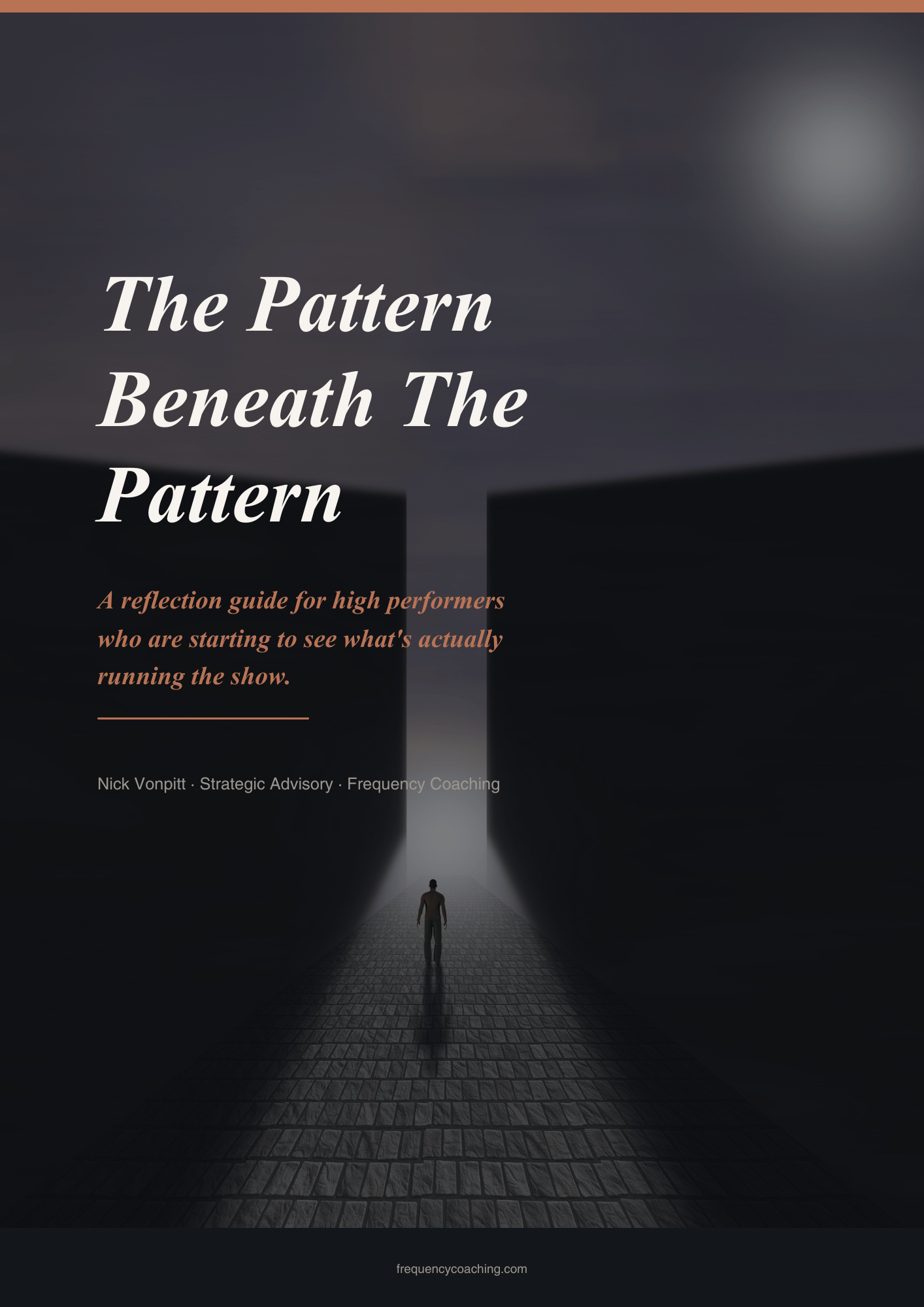
The Pattern Beneath the Performance
A reflection guide for people carrying significant responsibility. Not homework. Not another productivity exercise. A guided process for noticing the patterns that may still be shaping your leadership, relationships, decisions and capacity — particularly the ones that have become so familiar they no longer look like patterns at all.
Download the guide free →