The Unseen Cost of High Performance
Most people optimise performance. Very few understand the cost of sustaining it.
Why Your Nervous System Holds the Key to Everything
Most high performers do not have a thinking problem. They have a regulation problem.
If you are reading this, there is a strong chance that you are someone who has achieved what most people only aspire to. You have built something meaningful, led others, carried responsibility, and consistently shown up when it mattered most. From the outside, there is very little to question.
And yet, somewhere along the way, something shifted.
Not in your capability or intelligence, but in how it feels to operate at the level you do. The weight of decisions has become heavier, the stakes feel more personal, and rest no longer restores you in the way it once did. Your mind does not switch off easily, and being wrong carries a level of pressure that feels disproportionate to the moment.
This is not failure. This is pattern recognition.
Over time, your nervous system has adapted to sustained demand, and it has learned to remain slightly activated, even when there is no immediate threat. The issue is not that your system learned this, but that it never learned how to come back down.
Recognition
You Are Not Broken. Your System Is Overloaded.
Sustained high performance is not only shaped by what you achieve, but by what you carry while achieving it. When pressure becomes consistent, your system begins to normalise a heightened state of alertness. You become efficient within it, productive within it, and even successful within it.
However, what feels like drive is often underpinned by tension, and what feels like control is often supported by vigilance.
This is where the distortion begins to emerge. It does not show up in your knowledge or ability, but in your perception of yourself and the situations around you. You may notice that things which once felt manageable now feel heavier, and situations that should be instructive begin to feel personal.
The Hidden Cost
What Happens When “On” Becomes Your Only Setting
There’s a particular cost to being the person others rely on. The one who holds it together. The one who sees what needs to happen and makes it happen.
At first, this is energizing. It’s part of why you do what you do.
But over time, if your nervous system never fully disengages, something begins to erode.
The distortion isn’t in what you know. It’s in how you perceive.
When your system is chronically activated, your brain shifts into a different mode of operation. Not because you’re anxious or weak, but because this is what the nervous system is designed to do when it detects ongoing threat.
Research in neuroscience shows that when the amygdala—your threat detection center—is activated, access to the prefrontal cortex becomes limited. This is the part of your brain responsible for rational decision-making, complex problem-solving, and emotional regulation.
In practical terms: the more activated you are, the less clearly you can think.
What This Looks Like on the Surface:
Overthinking decisions that should be straightforward
Emotional reactivity that doesn’t match the situation
Difficulty making choices, even when you have all the information
Feeling exposed when receiving feedback
Withdrawing when you need connection most
What’s Actually Happening:
Your system is operating from protection, not clarity
Perception is being filtered through activation
Identity and behavior have become fused
Your baseline has shifted without you realizing it
Rest doesn’t feel safe anymore
The Identity Trap
One of the most significant shifts that occurs under sustained activation is the fusion between behaviour and identity.
Instead of experiencing a mistake as something that happened, it becomes something that defines you. Instead of recognising an off day as part of a broader pattern, it begins to feel like a reflection of your capability. This is where perfectionism, defensiveness, and chronic self-doubt begin to take hold.
The challenge for high performers is that you are often intelligent enough to recognise that something is off, but analytical enough to try and think your way out of it. Unfortunately, this is the very approach that reinforces the pattern.
The Archetypes of Dysregulation
This pattern does not present the same way for everyone. It tends to organise itself into recognisable archetypes that reflect how your system has adapted to sustained pressure.
The Scattered Operator tends to remain constantly engaged, moving from task to task without ever feeling fully complete. Productivity is high, but clarity is inconsistent, and there is a persistent sense of being behind.
The Controlled Performer maintains composure externally, but internally operates with tension and tightness. There is a strong need to get things right, and mistakes carry more weight than they objectively should.
The Numb Executor continues to perform and deliver, but with a noticeable loss of emotional engagement. There is a sense of disconnection, where things are working, but they no longer feel meaningful.
The Overextended Leader carries responsibility across multiple areas of life, often becoming the stabilising force for others. Over time, this creates a system that has very little space to reset, leading to cumulative fatigue.
These are not personality traits. They are patterns of regulation that have become normalised.
Discover Your Archetype
If you want to understand how this is showing up for you personally, you can take the Capcaity Assessment below. It will highlight where your energy is being drained and which patterns are currently shaping your baseline.
You Cannot Outthink a Dysregulated System
Most approaches to performance attempt to solve these challenges at the level of thought. They rely on strategy, reframing, or increased discipline. While these tools have value, they are ineffective when the system underneath them is activated.
When your nervous system is in a heightened state, your brain is not prioritising clarity. It is prioritising protection. This means that even the most rational strategy can feel inaccessible in the moment.
This is why what appears to be a thinking problem is often a regulation problem. Until the system is addressed, the pattern will continue to repeat.
Why EFT Specifically
EFT, or Emotional Freedom Techniques, operates at the level of the system rather than the level of thought. It combines focused attention with stimulation of specific acupressure points on the body, which has been shown to influence both physiological and neurological responses.
Research has demonstrated that EFT can significantly reduce cortisol levels, which is the body’s primary stress hormone. In some studies, reductions of up to forty percent have been observed after a single session. Lower cortisol levels are associated with improved emotional regulation, reduced anxiety, and greater cognitive clarity.
Additionally, emerging evidence suggests that EFT can help reduce activity in the amygdala while increasing access to the prefrontal cortex. This effectively allows the brain to shift out of a threat-based state and back into a state where reasoning and decision-making are available.
However, the true value of EFT is not in the mechanics, but in the effect it creates.
It introduces separation.
Separation between what happened, what you feel, and what you have made it mean about yourself. Once that separation is present, identity and behaviour begin to disentangle, and what once felt personal becomes workable.
EFT in Practice
Understanding this concept intellectually is one thing, but seeing it applied in real time provides a different level of clarity.
Below is an example of working with one of the most common patterns in high performers, which is the fear of being wrong. This pattern often sits beneath overthinking, hesitation, and the need to control outcomes.
In this process, the goal is not to change the thought directly, but to reduce the emotional charge attached to it. Once the intensity drops, the system naturally returns to a state where clearer thinking becomes available.
The Framework
How We Work: Align → Activate → Amplify
Most approaches to performance optimization start with action. Do more. Optimize better. Execute faster.
But if the system is dysregulated, all that does is compound the problem.
This is why my work operates differently. We don’t start with action. We start with alignment. And we don’t move to amplification until the system is regulated enough to hold it.
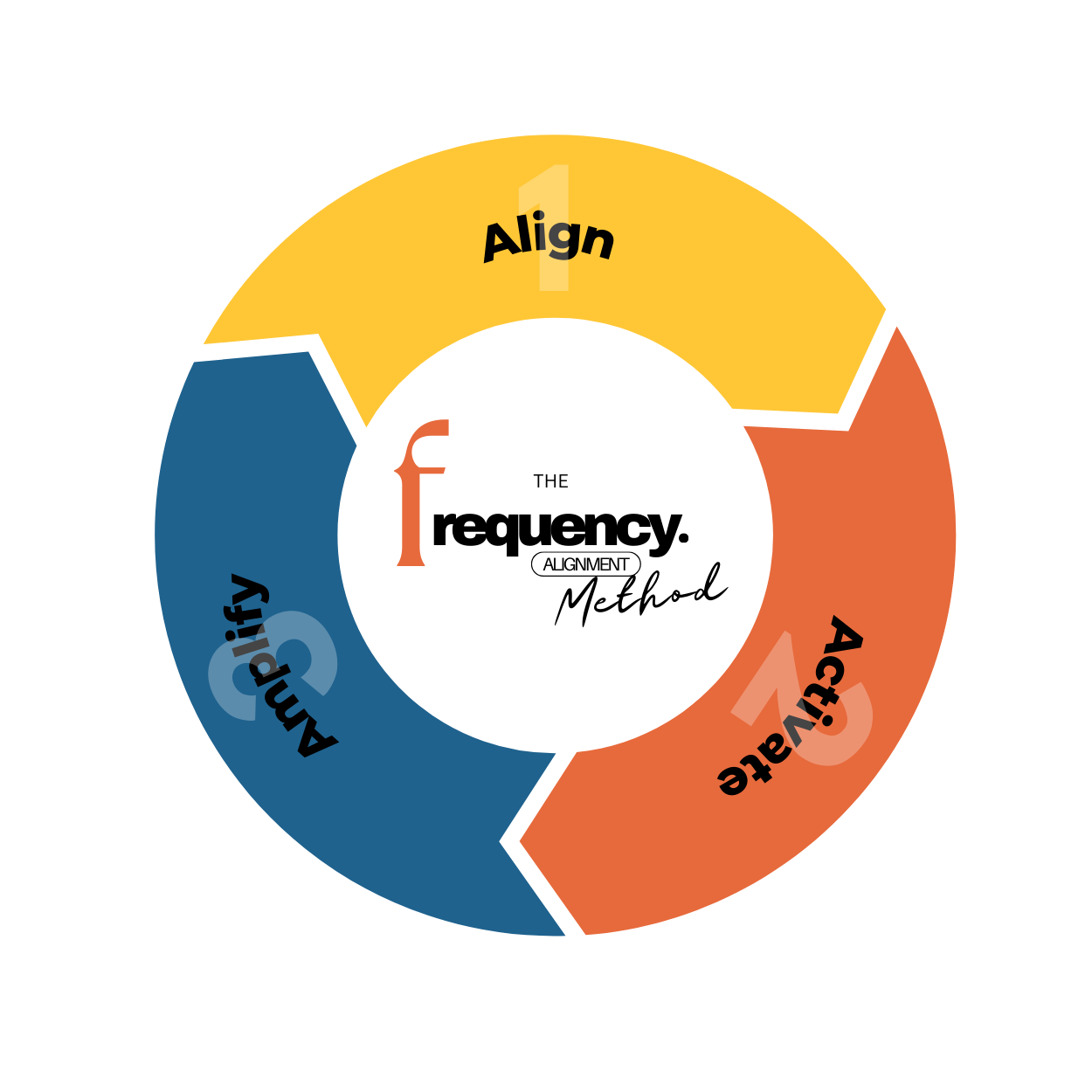
This is why my work operates differently. We don’t start with action. We start with alignment. And we don’t move to amplification until the system is regulated enough to hold it.
01: Align
We identify the pattern, the belief, and the distortion. What’s actually happening beneath the behavior? What meaning has your system attached to the experience? Where has identity become fused with outcome?
02: Activate
This is where we regulate the system. Not as a ritual, but as a way to reduce the emotional charge enough to see clearly. EFT sits here - not as a standalone solution, but as a precision tool for creating space between trigger and response.
03: Amplify
From clarity, we move. We make decisions. We shift behavior. We step into what’s next. But we do it from a regulated baseline, which is why it sticks.
This is the part most people skip - they try to amplify from dysregulation, which is why change doesn’t hold.
Identity & Purpose
When your system is chronically activated, your connection to purpose begins to weaken. This is not because purpose has disappeared, but because it is no longer accessible from your current state.
Purpose is not something that is thought through. It is something that is felt.
If your system is overloaded, you may still perform at a high level, but the experience becomes mechanical rather than meaningful. Over time, this creates a sense of disconnection, where you begin to question not only what you are doing, but why you are doing it.
For Parents
When Your Regulation Becomes Their Foundation
Children do not learn regulation through instruction. They learn it through experience.
They co-regulate with the adults around them, which means they are constantly attuning to your nervous system. If your baseline is activated, they are experiencing that activation, even if nothing is explicitly wrong.
This shows up as:
Difficulty settling
Emotional volatility
Resistance
Sensitivity
These are not behavioural issues in isolation. They are reflections of a system that is still learning how to regulate.
A Different Baseline
The goal of this work is not to remove pressure from your life. Pressure is an inevitable part of leadership, growth, and responsibility.
The goal is to change your baseline so that pressure does not automatically translate into stress.
When your system is regulated, uncertainty no longer feels like threat, being wrong no longer feels like collapse, and rest no longer feels like something you have to earn.
Questions That Often Come Up
-
In many cases, the thinking patterns people try to change are being driven by an activated system. When the nervous system is dysregulated, perception becomes biased toward protection. This means that even accurate thinking can feel uncertain or unsafe. Addressing the system first often changes the quality of thinking without needing to force it.
-
High performers tend to operate under sustained levels of responsibility, decision-making pressure, and internal standards. Over time, this creates a system that is highly efficient under stress, but less practiced at recovery. The challenge is not capability, but the lack of contrast between activation and regulation.
-
Description text goes hereEFT operates beneath traditional mindset work. While coaching helps bring awareness to patterns and behaviours, EFT helps regulate the emotional charge that keeps those patterns in place. When used together, it becomes easier to create meaningful and sustainable change
-
It often shows up subtly at first. You may notice that decisions feel heavier than they should, rest does not fully restore you, or you find yourself overthinking situations that previously felt straightforward. Over time, this becomes normalised, which is why many people do not recognise it until it becomes more pronounced.
-
No. Stress is a natural and necessary part of growth and leadership. The goal is to change your relationship to it so that it no longer drives your baseline state. When your system is regulated, you can experience pressure without being controlled by it.
The Work Ahead
If something in this resonated, it is likely not new to you. You have felt it, even if you have not had the language for it.
You are not broken. Your system has adapted.
The question is whether you are willing to retrain it.
Start here:
Watch the EFT session above and notice what shifts in your body as you follow along. Take the Power Leak Assessment and identify where your energy is currently being drained. Begin observing where you are operating from pressure instead of clarity.
That alone will begin to change more than you expect.
The work doesn't end when the reading does.
If something in this piece landed — a recognition, a discomfort, a quiet knowing — that's worth paying attention to. There are two places to go from here.
The Power Leak Scorecard
Most high-performers aren't broken. They're leaking. This scorecard helps you locate exactly where your energy is bleeding — so you know what to work on first.
Take the scorecard →Work With Nick
If you're a high-performer who looks successful on the outside but feels something is off underneath — this is the work. A conversation costs nothing. Your current state might.
Apply to work together →
Nick Vonpitt works with executives and entrepreneurs navigating burnout, identity strain, and the gap between external success and internal alignment. Based in South Africa. Available internationally.